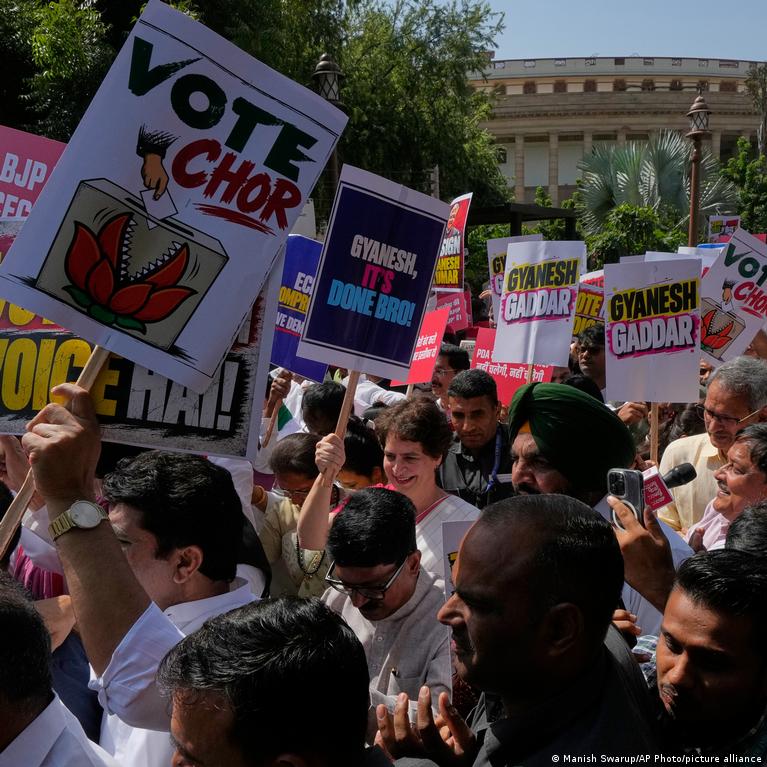
Hundreds of opposition supporters marched towards India’s Supreme Court on Monday, challenging the removal of millions of names from electoral registers in a dispute that has triggered widespread protests and mounted pressure on Prime Minister Narendra Modi’s government.
Opposition parties and members of the youth-led Cockroach Janta Party (CJP) have staged repeated demonstrations this month, demanding the resignation of Chief Election Commissioner Gyanesh Kumar over the voter registration review, which critics accuse of favouring Modi’s Bharatiya Janata Party (BJP).
The exercise, which began last year, reportedly resulted in more than 130 million names being removed from voter lists. The affected records include approximately 28 million deceased voters, 63 million people who had relocated and 30 million individuals whose whereabouts could not be established.
Tensions escalated over the weekend as police detained thousands of demonstrators, including youth movement leaders, while security forces blocked protesters attempting to march through central Delhi. Authorities deployed thousands of personnel to contain the demonstrations.
The Election Commission has rejected accusations of political bias, maintaining that eligible voters whose names were wrongly removed can register again. The BJP has also dismissed the criticism, accusing opposition parties of undermining democratic institutions by questioning legitimate electoral procedures.
Opposition leaders are now seeking judicial intervention over the voter list revision after Chief Justice Surya Kant declined their request for a meeting, advising them to submit a formal petition instead.
He said the matter was already before the court and that discussing pending cases outside judicial proceedings would conflict with established ethical principles.
Hundreds of opposition members and left-wing student activists joined Monday’s march, while senior political figures travelled to the court by bus. Demonstrators accused the authorities of weakening democratic institutions and threatening their independence.
Security measures were tightened across the capital ahead of the protest, with six metro stations shut for 10 hours and traffic restrictions imposed on more than 20 road sections. Riot-control personnel guarded central Delhi, major routes were barricaded and water cannons were placed on standby.
Authorities Designate New Protest Venues
The BJP has accused the opposition Congress party of using the demonstrations to regain political power. Agriculture Minister Shivraj Singh Chouhan argued that the protests were intended to discredit constitutional institutions and create disorder for political advantage.
In a separate development, Delhi Police withdrew Jantar Mantar’s designation as an authorised protest location and identified three alternative venues, according to an official order seen by Reuters.
The historic site has hosted demonstrations for decades and was used earlier this year by CJP supporters, who staged a prolonged sit-in demanding the resignation of Education Minister Dharmendra Pradhan over allegations involving examination paper leaks.
CJP leaders have also met with Delhi Police to seek a date for a peaceful demonstration, warning that they would announce another protest if the authorities failed to respond within 24 hours.
The youth movement has emerged as a significant challenge to Modi’s government, organising demonstrations in recent months over issues including inadequate public school infrastructure and employment opportunities.
The latest unrest followed a report by the Indian Express newspaper last month alleging that two deputy election commissioners had raised internal concerns about the voter list revision, registration procedures and digital systems used in the process.
Opposition parties further allege that Muslim voters and other minority communities, whom they consider less likely to support the ruling Hindu nationalist BJP, have been disproportionately affected by the deletions. Both the Election Commission and the governing party have rejected the allegations.